A conversation about Carl Jung and J.R.R. Tolkien, active imagination, subcreation, archetypal figures, the imaginal realm, and the transformative relationship between creativity and the unconscious.
What if imagination is not simply something we create, but something we encounter?
In this episode of the Alchemical Toil Podcast, Alexis Durgee sits down with scholar, artist, and author Becca Tarnas to explore the remarkable parallels between Carl Jung's The Red Book and J.R.R. Tolkien's imaginative world of Middle-earth.
Drawing on her research into Jung and Tolkien, Becca examines active imagination, subcreation, and the ways both men experienced images and characters that seemed to possess a life beyond their conscious intentions.
Their conversation moves through archetypal figures, the anima, the world soul, and the relationship between imagination and reality.
Together, they consider a central question: What changes when we approach imagination not merely as fantasy, but as a meaningful way of encountering and participating in the world?
In this episode, Alexis and Becca explore:
The parallels between Carl Jung and J.R.R. Tolkien
Jung's The Red Book and Tolkien's imaginative world of Middle-earth
Becca's early encounters with Tolkien's stories
Active imagination and the emergence of unconscious imagery
Tolkien's concept of subcreation and enchantment
Imagination as discovery rather than invention
The relationship between creative inspiration and artistic discipline
Philemon, Gandalf, and the wise old man archetype
The anima, Galadriel, and the Queen of Faerie
The anima mundi, or world soul, and the imaginal realm
How creative work can transform the creator
The power, responsibility, and potential dangers of imagination
Listen to the Episode
Listen to Jung, Tolkien & the Power of Imagination with Becca Tarnas on the Alchemical Toil Podcast.
LISTEN ON APPLE PODCASTS | LISTEN ON SPOTIFY | WATCH ON YOUTUBE
Jung, Tolkien & the Imaginative World
Although Jung and Tolkien approached imagination through different disciplines, Becca identifies striking similarities in their creative experiences. Jung's The Red Book emerged through encounters with unconscious imagery, while Tolkien described discovering aspects of Middle-earth rather than consciously inventing every detail. Both approached their imaginative worlds with a sense of curiosity and receptivity.
Their work raises questions about the relationship between imagination, consciousness, and the mysterious origins of creative experience.
Active Imagination & Subcreation
Alexis and Becca explore Jung's practice of active imagination alongside Tolkien's concept of subcreation. Both involve attending to images that arise spontaneously while consciously participating in their development. For Jung, this meant entering into dialogue with unconscious figures; for Tolkien, it involved shaping an imaginative world through language and storytelling.
Becca describes creativity as a process of listening as well as making, in which the artist gives form to something that cannot be entirely controlled.
Philemon, Gandalf & Archetypal Figures
The conversation considers the parallels between Philemon, a significant figure in Jung's visionary experiences, and Gandalf, Tolkien's wise and enigmatic guide. Both evoke the wise old man archetype, suggesting forms of knowledge that extend beyond ordinary conscious understanding.
Alexis and Becca also explore feminine figures such as Galadriel and the Queen of Faerie, considering their relationship to the anima, enchantment, and the archetypal imagination.
Enchantment & the World Soul
Becca explores the imaginal realm as a way of understanding experiences that cannot be reduced to either literal reality or meaningless fantasy. Drawing on Jungian and philosophical perspectives, the conversation considers the anima mundi, or world soul, and the possibility that imagination connects us with dimensions of meaning beyond the individual psyche.
Rather than dismissing enchantment as escapism, Alexis and Becca consider what imaginative experience might reveal about our relationship with the wider world.
When Imagination Changes Us
Imagination does not necessarily leave its participants unchanged. Becca reflects on the reciprocal relationship between researchers and their subjects, questioning how the material we study might also shape our understanding of ourselves.
The conversation acknowledges that imagination can be unsettling as well as illuminating. Its transformative possibilities require discernment, attention, and a willingness to encounter what emerges without immediately attempting to control it.

ABOUT | Becca Tarnas
Becca Tarnas is a scholar, artist, counseling astrologer, and author whose work explores philosophy, mythology, archetypal psychology, and the imagination.
She holds a PhD in Philosophy and Religion from the California Institute of Integral Studies, where her doctoral research examined the parallels between Carl Jung's The Red Book and the writings of J.R.R. Tolkien.
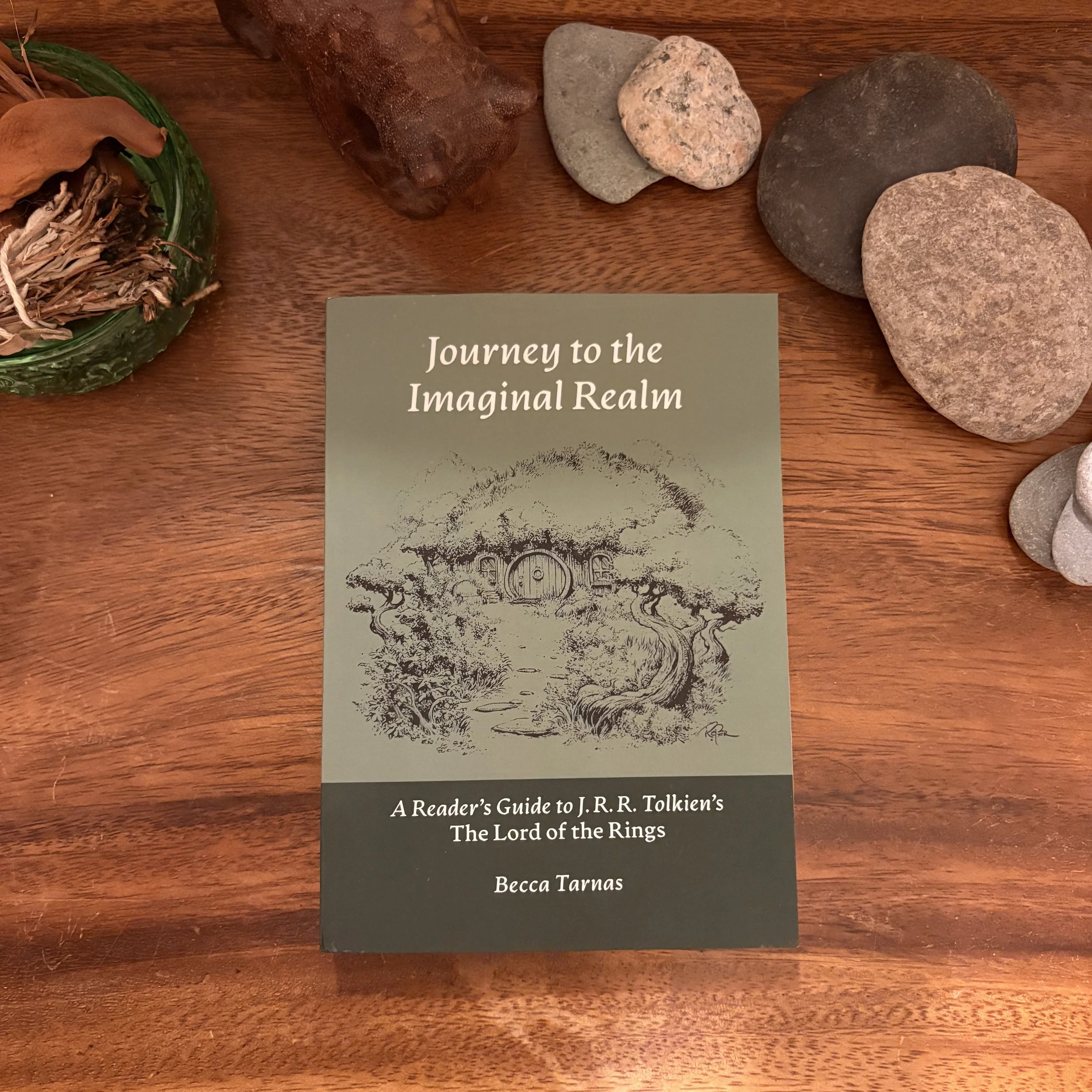
She is the author of Journey to the Imaginal: A Reader's Guide to J.R.R. Tolkien's The Lord of the Rings, which explores Tolkien's work through imagination, mythology, and archetypal psychology.
Listen to the Episode
Listen to Jung, Tolkien & the Power of Imagination with Becca Tarnas on the Alchemical Toil Podcast.
LISTEN ON APPLE PODCASTS | LISTEN ON SPOTIFY | WATCH ON YOUTUBE
Explore Further
Becca Tarnas
Journey to the Imaginal: A Reader's Guide to J.R.R. Tolkien's The Lord of the Rings
The Back of Beyond: The Red Books of C. G. Jung and J. R. R. Tolkien
Mentioned & Explored in This Episode
C. G. Jung — The Red Book
J.R.R. Tolkien — The Lord of the Rings
Tolkien — The Hobbit
Tolkien — On Fairy-Stories
Active imagination and subcreation
Philemon and Gandalf
The wise old man archetype
The anima and Galadriel
The Queen of Faerie
The anima mundi and imaginal realm
Enchantment and creativity
Psychological transformation
Alchemical Toil explores the inner life through conversations at the intersection of Jungian and depth psychology, psychoanalysis, mythology, embodiment, imagination, and the unconscious.